The Strait of Hormuz is one of the world’s most important maritime chokepoints. It connects the Persian Gulf with the Arabian Sea and carries substantial volumes of oil, liquefied natural gas and commercial cargo.
For Gulf countries, it is the principal maritime gateway to international markets. For countries across Asia and Europe, it is an essential part of the energy and trade network supporting manufacturing, transport and consumer demand.
For international trade, the principal danger is not simply what has already happened. It is the possibility that continued escalation may make normal shipping operations increasingly difficult, expensive or, in some cases, temporarily unviable.
History tells us this is nothing new
History repeatedly demonstrates that conflict around strategic maritime chokepoints rarely remains a local problem.
During the Suez Crisis of 1956, the closure of the canal forced vessels to sail around the Cape of Good Hope, adding considerable distance, cost and time to voyages between Asia and Europe.
During the Tanker War of the 1980s, commercial vessels and energy infrastructure in the Gulf became direct targets as Iran and Iraq attempted to disrupt each other’s exports. Shipping continued, but only with much higher security risks and, in some cases, naval protection.
More recently, the Ever Given blocked the Suez Canal for nearly a week in 2021, delaying hundreds of vessels. From late 2023 onwards, attacks on Red Sea shipping again forced many carriers to avoid Suez and sail around southern Africa.
The pattern is remarkably consistent. When one of the world’s principal shipping routes becomes unsafe or unavailable, goods do not simply stop moving. They move by longer, slower and substantially more expensive routes.
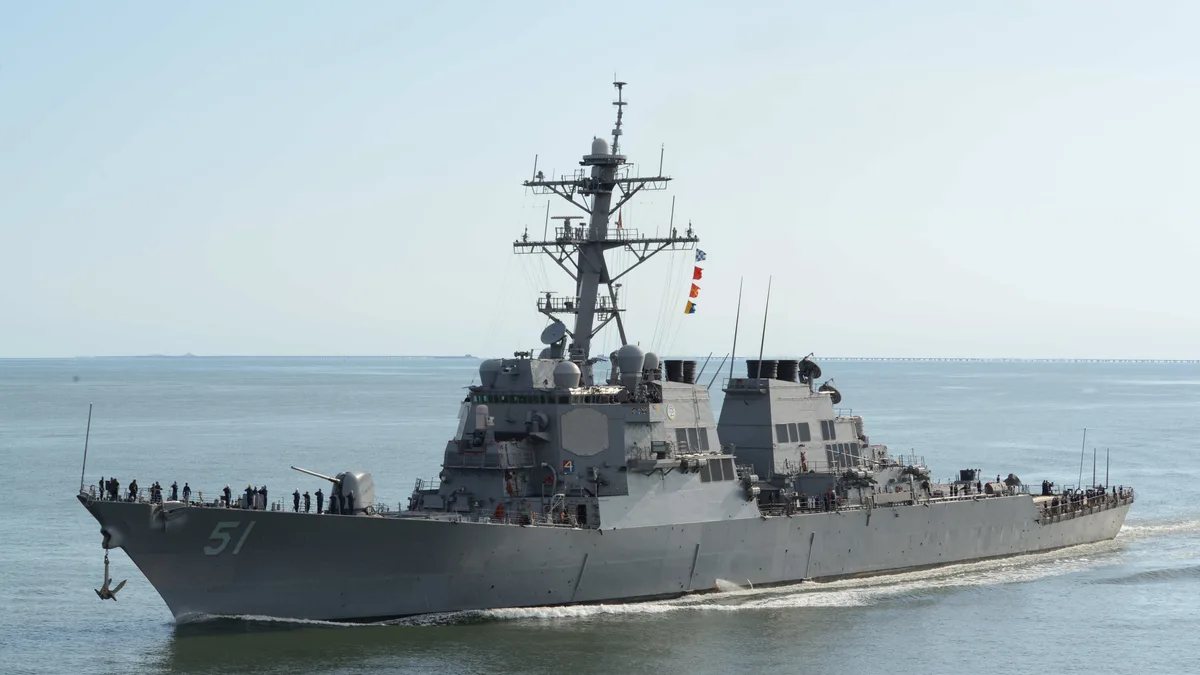
Foto: Wikimedia Commons / U.S. Navy
Summary of Gulf Conflict Impacts on Global Freight
The ongoing conflict has substantially disrupted global logistics, affecting freight rates, operational transit times, and insurance costs across multiple sectors:
Freight Rates Surge
Transport costs have climbed sharply. Ocean container freight rates from Shanghai to Jebel Ali quadrupled, while Asia-US rates doubled and bunker fuel rose by around 55%. Tanker daily charter costs exceeded $400,000 on Middle East–China routes, LNG shipping rates increased by over 40%, and Southeast Asia–Europe air freight rates rose past 6%.
Transit Times & Operational Constraints
Bypassing the Strait of Hormuz has forced complex multimodal transfers. Cargo rerouted via the Cape of Good Hope added 10 to 14 days to journeys, while UAE ports faced 7-to-10-day congestion delays. Although rail via the Middle Corridor is faster (15 to 18 days), its capacity remains limited. Meanwhile, air freight capacity was severely cut due to airspace restrictions, with major carriers running at only 20% to 60% of normal schedules.
Insurance and Surcharges
Vessel war-risk insurance premiums in the Gulf experienced a twenty-fold surge, escalating from roughly 0.25% to as high as 5% of hull value. Carriers are also frequently implementing post-quotation surcharges for security, congestion, fuel, and diversions.
Read more about the impacts of this conflict in our article.
What the conflict means for freight forwarders
For freight forwarders, the renewed conflict creates both substantial operational pressure and a greater responsibility to guide customers properly.
Since carrier rates, schedules, and surcharges can change rapidly with little notice, quotations require shorter validity periods, clearer exclusions, and stronger terms regarding war risk, fuel adjustments, port congestion, and carrier-imposed charges.
Forwarders must evaluate more than headline freight rates; cheaper routes often entail longer transits, unreliable transshipments, or greater disruption risks. The correct advice may be to recommend costlier but dependable routes, split cargo across services, or prioritize urgent shipments via air freight.
Cash-flow exposure is another serious issue. Carriers and suppliers may demand payment before releasing space, while customers may expect normal credit terms. Forwarders must avoid financing rapidly increasing freight and surcharge costs without suitable credit control or advance-payment arrangements.
Clear communication is equally vital. Customers must be clearly informed that rates, transit times, and routings are provisional while hostilities continue. Because silence or overconfidence breeds disputes, regular and factual updates are essential to protect both customer relationships and the forwarder’s commercial position.
Looking ahead
The current situation remains highly fluid. After three consecutive days of renewed hostilities, the risk of further escalation is serious. Commercial vessels have reportedly been attacked, tanker traffic has fallen and both the United States and Iran have hardened their positions around the Strait of Hormuz.
No one can state with confidence how long the present escalation will last or whether the conflict will widen. Businesses should therefore plan around scenarios rather than a single assumption.
The sensible approach is to prepare for continued volatility: higher freight rates, longer transit times, tighter capacity and sudden carrier surcharges. Importers and exporters should build additional time into their supply chains, examine quotation terms carefully and discuss alternatives before cargo becomes urgent.
At Mercium, we continue to monitor developments across the Gulf and the wider freight market closely. We work with shipping lines, airlines, hauliers and customs partners to assess realistic routing options, expected costs and operational risks. Our objective is not simply to provide a freight rate, but to help customers make informed decisions and keep their supply chains moving during an increasingly uncertain period.